
EscaTEQ Method™ — Case Study B
Rotterdam Centraal
Facility
Transit Hub
Escalators
30 (mixed indoor/outdoor)
Operating
~18 hrs/day
Traffic
~5.000 riders/day
Executive Summary
• Environment: Class B transit hub (~5000 riders/day)
• Scope: 30 escalators
• Starting Condition: Class B (moderate contamination)
• Method: EscaTEQ Method™ (low-moisture, surface-only)
• Outcome: Reduction in visible surface soil was observed; condition remained within Class B parameters at the time of service.
Photo Documentation
Before Cleaning – Class B surface condition (26-02-2026)
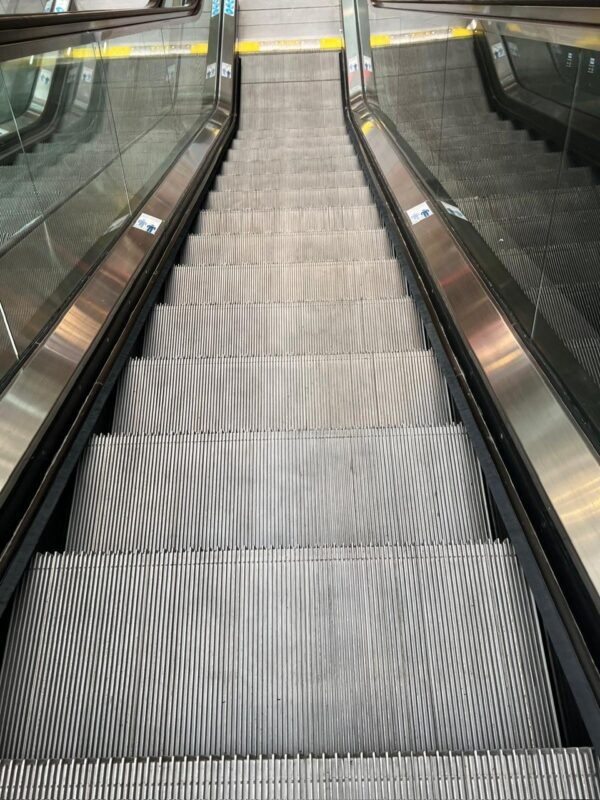
After Cleaning – Post-cleaning condition after 6 sequences (26-02-2026)
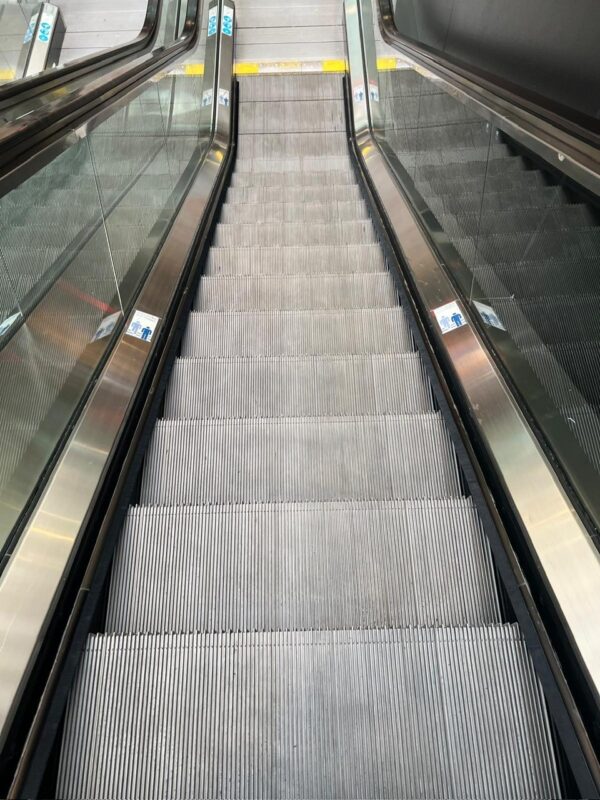
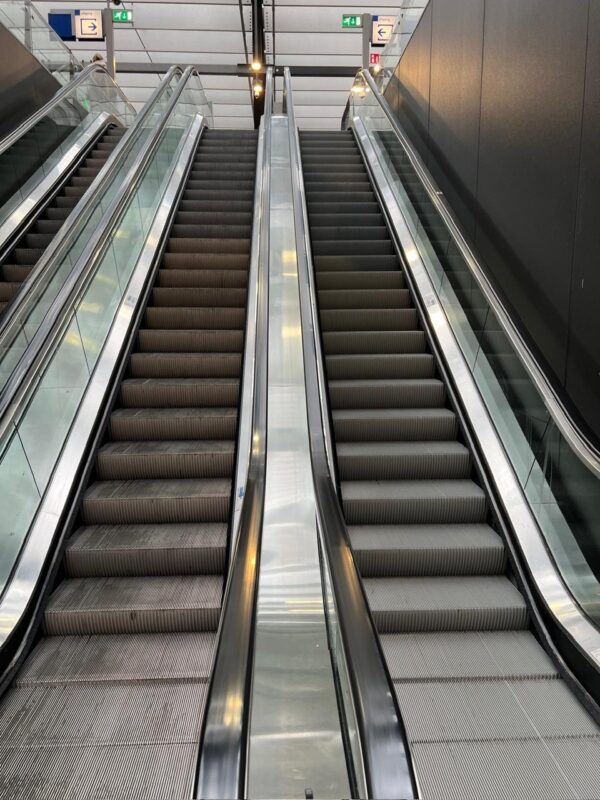
Overview – Post-cleaning condition compared to a non-cleaned escalator
Cleaning Sequences Executed
6
Traffic Classification
Busy (≈5000 riders/day)
Active Cleaning Duration
Approx. 6 min
Suggested Frequency (Traffic-Based)
Weekly
Liquid Usage
~350 ml / escalator
Actual Site Frequency
Every 2 weeks
Pads
2 / escalator
Condition
Class B
Condition Assessment
Observed surface contamination consistent with Class B at time of service.
Contamination type: moderate soil accumulation with visible stains.
Embedding within step grooves: moderate, compacted presence.
Step definition visibility: clearly visible across full width.
Overall condition statement: moderate contamination was observed, with visible compaction and no evidence of deep embedding; prior cleaning activity was indicated.
Frequency Position
EscaTEQ Method™ recommended operational starting point for this traffic profile was weekly.
Actual site-applied frequency: every 2 weeks.
No observable condition degradation was noted at the time of service.
Final frequency should remain subject to contamination rate, facility profile, OEM guidance, and engineering or maintenance-provider review.
Work Performed
Method: EscaTEQ Method™
Application type: surface-only, low-moisture cleaning applied only to exposed step surfaces.
Operator configuration: single operator.
Cleaning sequence definition: one complete rotation of the escalator step band.
Observed Outcome
A reduction in visible surface soil was observed at the time of service.
Observed condition remained stable at the time of service.
No operational disruption was observed at the time of service.
No condition escalation was observed at the time of service.
Outcome Narrative
Observed condition remained stable at the time of service under defined labor and material inputs. The site-applied frequency was every 2 weeks, while the EscaTEQ Method™ recommended operational starting point for this traffic profile was weekly. No condition escalation was observed. Preventive surface-cleaning frequency should remain subject to contamination rate, facility profile, OEM guidance, and engineering or maintenance-provider review.
Lessons Learned
-
Defined labor and material inputs were observed during the applied cleaning sequence.
- Observed condition remained stable under the site-applied frequency.
- Preventive surface-cleaning frequency should remain site-specific and subject to engineering or maintenance-provider review.
Observations in this case study are based on internal operational records, site conditions, and photographic evidence for the referenced period. This case study describes site-specific outcomes and should not be interpreted as a universal performance claim.